

It’s Our Story
Last week’s Torah reading was mostly the story of Noah and the Flood. One of the more curious elements of the tale is what happens when the earth dries out enough for the animals and their human tenders to exit the vessel.
Bee Juice
My recent posts...After havdala ended last week’s Galeem (“waves,” our Sunday school), the usual joyful mayhem erupted in the lobby: Kids running down halls for a water bottle, a work of art, a lollipop; parents calling after them “Remember your ________!”; brief...
Welcome to”chol”
A couple days of magnificent weather have been a welcome respite from the bounty of precipitation during Sukkot and the closing festival days. This morning, we stored away our sukkah — unscathed by the nor’easter — for next year.
Kol Nidre – All Vows
My recent posts...kol nidrei, all MY vows? Rabbi Jonathan Kremer kol nidrei, all vows. ALL vows? All my vows? How can I possibly remember them all? Those silent frustrations: I swear I could... I said what? Well, I didn't mean it that way! The thick-as-mud silent...
Shalshelet
The nearly 305,000 words of a handwritten Torah scroll tell tales, state laws and inspire ideas. It is devoid of some useful things like vowels, punctuation and cantillation marks. Cantillation, or trope, is the musical chanting that can help bring Torah text alive when it’s read aloud, as during services.
Our Torah trope system was standardized by the 10th century. Of course (we are Jews, after all), different melodic modes — Ashkenazi, Sfaradi, Yemeni, et. al. — developed over time.
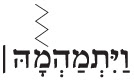
One rare trope symbol is the “shalshelet.” The name is from the root “shelosha,” the number three, because it is a three-part arpeggio. It appears only four times in Torah. Each of those times is a key moment in an episode. This week, it highlights the word “vayitmahmah,” meaning, “and he hesitated,” or “still he delayed (JPS).”
A little background. Our biblical patriarch Avraham is a decisive person; when God tells him to go or to do, he goes or does. When his nephew Lot is captured in a military conflict, Avraham rescues him. Avraham has the chutzpah to challenge God’s decision to destroy two cities that have descended into moral depravity.
Lot, now dwelling in one of those cities, is visited by a pair of emissaries sent by God to save him. They insist that he and his family come with them to a distant safe place, but Lot hesitates, “vayitmahmah.” They forcibly take him with them.
Lot dithered. His hesitation, misgiving, is in stark contrast to Avraham’s decisiveness and faith; this is highlighted by the shalshelet on the words meaning “he hesitated.”
Ah, there’s more! Following the word and its distinctive trope is a vertical line called a “passek.” As Joshua Jacobson explains in Chanting the Hebrew Bible, his encyclopædic tome on cantillation, the shalshelet is most appropriate here. Jacobson cites the 11th-century German Talmudist and poet Tuvya ben Eliezer, author of “Lekach Tov” (good teaching): The shalshelet indicates hesitation, while the accompanying “passek” is a sign of reconsideration, repeated wavering.
It is perhaps disappointing that, at the end of this parsha, when Avraham is ready (if not eager) to sacrifice his son Yitzchak at God’s behest, there is not a single shalshelet. Is the story of Yitzchak’s near-sacrifice made more challenging because Avraham did not hesitate, or would it have been even more problematic if he had?
PS: The shalshelet in the illustration is not proportional.
PPS: Shalshelet was the name of a foundation that promoted new melodies for liturgical use. At the second festival (2006), a piece of mine, written for a Yom Kippur piyyut (liturgical poem), was accepted for presentation and publication. Click here to listen.
Shabbat shalom ! שבת שלום