
It’s Our Story
Last week’s Torah reading was mostly the story of Noah and the Flood. One of the more curious elements of the tale is what happens when the earth dries out enough for the animals and their human tenders to exit the vessel.
Bee Juice
My recent posts...After havdala ended last week’s Galeem (“waves,” our Sunday school), the usual joyful mayhem erupted in the lobby: Kids running down halls for a water bottle, a work of art, a lollipop; parents calling after them “Remember your ________!”; brief...
Welcome to”chol”
A couple days of magnificent weather have been a welcome respite from the bounty of precipitation during Sukkot and the closing festival days. This morning, we stored away our sukkah — unscathed by the nor’easter — for next year.
Kol Nidre – All Vows
My recent posts...kol nidrei, all MY vows? Rabbi Jonathan Kremer kol nidrei, all vows. ALL vows? All my vows? How can I possibly remember them all? Those silent frustrations: I swear I could... I said what? Well, I didn't mean it that way! The thick-as-mud silent...
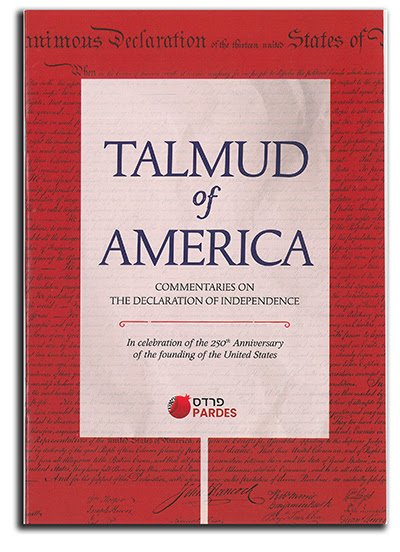
Talmud of America
Pardes Institute, a non-denominational study center based in Jerusalem, offers immersive Jewish learning around the world. One project is “Talmud of America,” which aims to illuminate and interpret, through Jewish eyes, some phrases of the Declaration of Independence using techniques of discourse and deconstruction honed in the many centuries and pages of rabbinic discussion known as the Talmud.
Of the texts examined in this little pamphlet, we will consider that among “certain unalienable rights … are Life, Liberty and the Pursuit of Happiness.” The commentary is by Yiscah Smith, an educator who views Judaism as a spiritual practice. With, of course, emendation by yours truly.
The Declaration states that Life Liberty and the Pursuit of Happiness are among the Divine Rights of every human. (Well, at least of every land-owning white man … in 1776.)
Are these rights or entitlements? “I don’t need to DO anything to have these rights. They’re just mine!” Flashing forward to the Constitution, we could see birthright citizenship as a “gimme” — you’re born here, you’re in! No fee, no test, no pledge.
A challenge of entitlements, of course, is that they can lead to selfishness, as in: I have these rights, you don’t! They are also vulnerable to changing circumstances, as we see today.
As with Torah, the Declaration and the Constitution are subject to ongoing interpretation and reinterpretation.
The Jewish view of a right, writes Smith, is that it must be earned. Rights such as they are in traditional Jewish thought are gained by being in service to a divine purpose, with Torah and personal or communal obligation as the the highest values.
LIFE
Implicit in the Declaration, an authority may not take a life without due cause or process, as opposed to the whim of a monarch. Thus, we have a right to life.
As Jews, our lives are not ours to do with as we please and therefore cannot be claimed as a right. The first words we utter — or sing! — upon awakening, modeh ani / I am grateful to be alive! — declare our dependence upon God for our very souls.
We don’t have a right to our lives; we are granted life every minute of every day … until we’re not.
LIBERTY
Just as light exists only in contrast to darkness, freedom may be defined by its constraints. In the Declaration, Thomas Jefferson doesn’t spell out what liberty means except in contrast to the dictates and actions of the English king. It is less about personal freedoms than the freedom of citizens to choose how to be governed, taxed, protected, or adjudicated.
Smith writes that to Rabbi Avraham Yitzchak Hakohen Kook, first chief rabbi of Israel, freedom is expressed or experienced less as personal autonomy than it is as an exalted personal spirit.
Social or economic status cannot be the only determinants of freedom. Rather, when we make decisions — for ourselves or for our communities — that recognize the spirit of God inherent in every person, we can earn the blessing of freedom.
HAPPINESS
How do you define happiness? Is it security? Joy? Business success? Appreciative children? Perfect grandchildren? (Wait! Aren’t they all!?)
The Declaration’s wording is not “Life, Liberty and Happiness;” it is “…the pursuit of happiness.” Rabbi Lord Jonathan Sacks writes that “happiness is not a state of having; happiness is a state of being…” That condition “depends on a sense of meaning and purpose in a life lived in accord with ethical ideals:” TORAH!
Seeking meaning and purpose can lead to happiness; “pursuit” encourages us to aspire to a higher state of being however we define what that is: Self-satisfaction? Confidence in our governance? Unity in our communities? All, of course, within the rubric of Torah.
Torah can help us pursue our ideals. In the commandment “tzedek tzedek tirdof, justice, pursue justice,” (Deut. 16:20) “pursue” implies that we might not be able to achieve the goal.
Torah, filtered through millennia of devoted sages and guides, is our declaration of allegiance, a pledge of fealty to a spiritual, communal and ultimately deeply personal pursuit of a rewarding life.
Likewise, for the citizens of these United States, our foundational documents are meant to guide us. As with Torah, interpretation can lead to new understandings. In the Declaration, for example, a rephrasing might encourage a shift from “right” to “aspiration” is that we are obliged to pursue “life, liberty and happiness.”
There is no finitude in pursuing these ideals; there can be generosity, cooperation and growth in the effort. As Rabbi Tarfon says in Pirkei Avot, teachings of our sages, we might not achieve the goal, but we may not desist from trying.
Perhaps what our ancient texts and relatively recent American documents have in common above all else is the message that our responsibility is immense. We may have a right to life, liberty and the pursuit of happiness, but we may not sit back and watch them dissipate.
So we pay attention. We vote. We advocate. We write. We speak with one another. We support. We uphold democracy.
And we seek to live fulfilling Jewish lives as we do so.
Let’s get to work!
Pick up a free compy of “Talmud of America” at Shirat Hayam